top of page
Editorial
Discover highlights, insights, and stories behind the artists.
Maestro
Artist Highlight
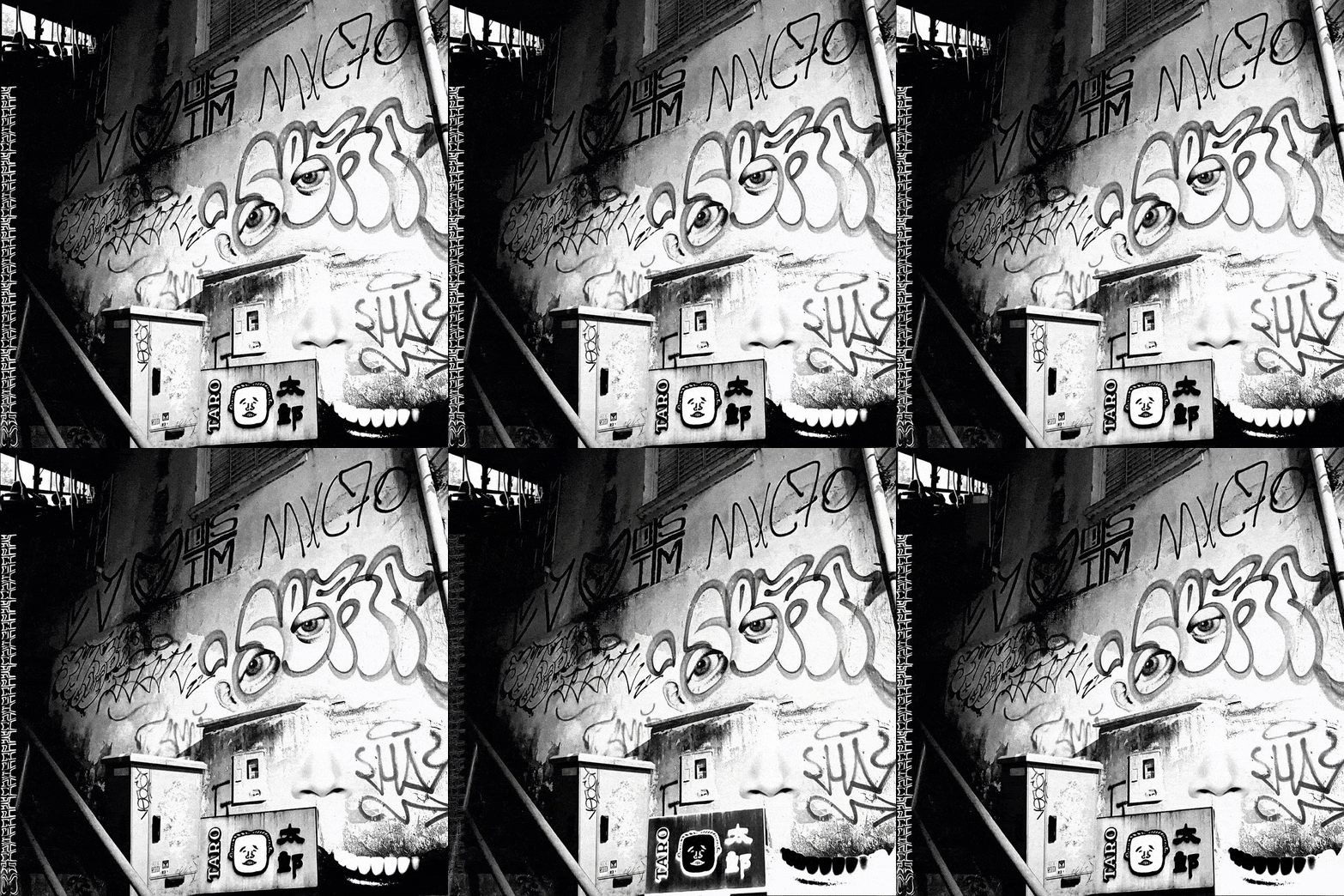
Maestro (b. 2005) operates at the intersection of analogue and digital, constructing intricate urban psychoscapes from his own photographic archive. Through heightened contrast, distortion, and precise layering, he reconfigures the familiar into something charged and quietly unsettling. The subway, a recurring presence in his work, functions less as a backdrop and more as a pulse—a structural metaphor for the negotiations between solitude and collective identity. As An observes, “He has an honesty towards his own emotions that is unusually rare.” Yet this honesty is not raw confession—it is deliberate, structured, and integral to his language. Personal memory slips into digital architecture without ever relinquishing control. Maestro’s vulnerability is intentional, revealing, and deeply human. His work encodes intimate narratives into urban landscapes, capturing the emotional currents running beneath the city’s surface—gestures, overheard conversations, and passing crowds become part of his creative cartography.
In Maestro’s hands, the city becomes more than a subject; it is a living presence. Bodies, transport systems, signage, and graffiti converge into dense, layered compositions that feel at once familiar and unsettling. He transforms urban spaces into psychological landscapes, preserving the rhythm, intensity, and humanity of lived experience, and carries that energy seamlessly into the digital realm. Maestro’s journey into Web3 reflects the same precision and care evident in his artistic practice. From early experimental releases to integration into platforms like SuperRare and Verse, his trajectory is deliberate rather than hurried. He is now preparing Trigger Warning, a series of six GIFs that stand among his most intimate and emotionally charged works. There are also whispers of projects poised for significant international stages in the near future.
One of the most compelling developments is Maestro’s upcoming work in Poços de Caldas, Brazil. This move is not nostalgic; it is strategic. Poços becomes a site of activation, a space where international attention is deliberately redirected. Working closely with Marcelo Abuchalla—artist and city’s secretary of culture—Maestro will explore new physical interventions, including a large-scale installation that may involve the painted façade of a building. This moment marks a pivotal convergence: years of practice, emotional precision, and curatorial dialogue meeting institutional interest and expanded scale. Maestro stands at the threshold of a chapter that feels both inevitable and newly unfolding—an artist shaping the city and allowing the city, in turn, to shape him. Between upcoming NFT releases, physical installations, and ongoing exploration, his instinctive response to urban life has evolved into a conscious, considered practice.
0009
Synthetic Bloom
The flowers seem soft and slightly padded, their shapes inviting but also a little uncanny. 0009 gathers and twists the fabric to suggest the delicate symmetry of petals. Pleats and seams give the works a sense of structure and space, while stitched and draped areas echo the natural growth of plants. The material itself, with its hints of warmth and protection, reminds us of clothing meant to shelter the body. When you look even closer, you begin to notice human figures within the composition. Faces and hands emerge, partly hidden by the textile blooms, creating a powerful contrast between what is living and what is not, between the natural and the artificial. From a distance, these pieces might seem like soft, dreamy fields of flowers. But up close, the illusion fades as the petals reveal themselves to be folds and seams of synthetic fabric. With Synthetic Bloom, 0009 builds on years of exploring fabric, form, and pattern.
The artist’s earlier interest in the small details of linings, pleats, and seams has grown into large, immersive works where fabric becomes both subject and structure. The folds and layers in these pieces remind us of both clothing and the shapes of the natural world. Where the fabric opens or parts, light and shadow highlight the fragility of this imagined landscape, shaped by human hands. In this series, 0009 invites viewers to think about where the natural ends and the artificial begins. By using fabric — a material tied to warmth, shelter, and daily life — to recreate scenes from nature, the artist blurs the line between what we think of as real and what is constructed. These works play with our perception, much like the art tradition of trompe-l’œil, but instead of using paint, 0009 uses fabric to create these illusions.
RAVERSE90
Heritage Collection
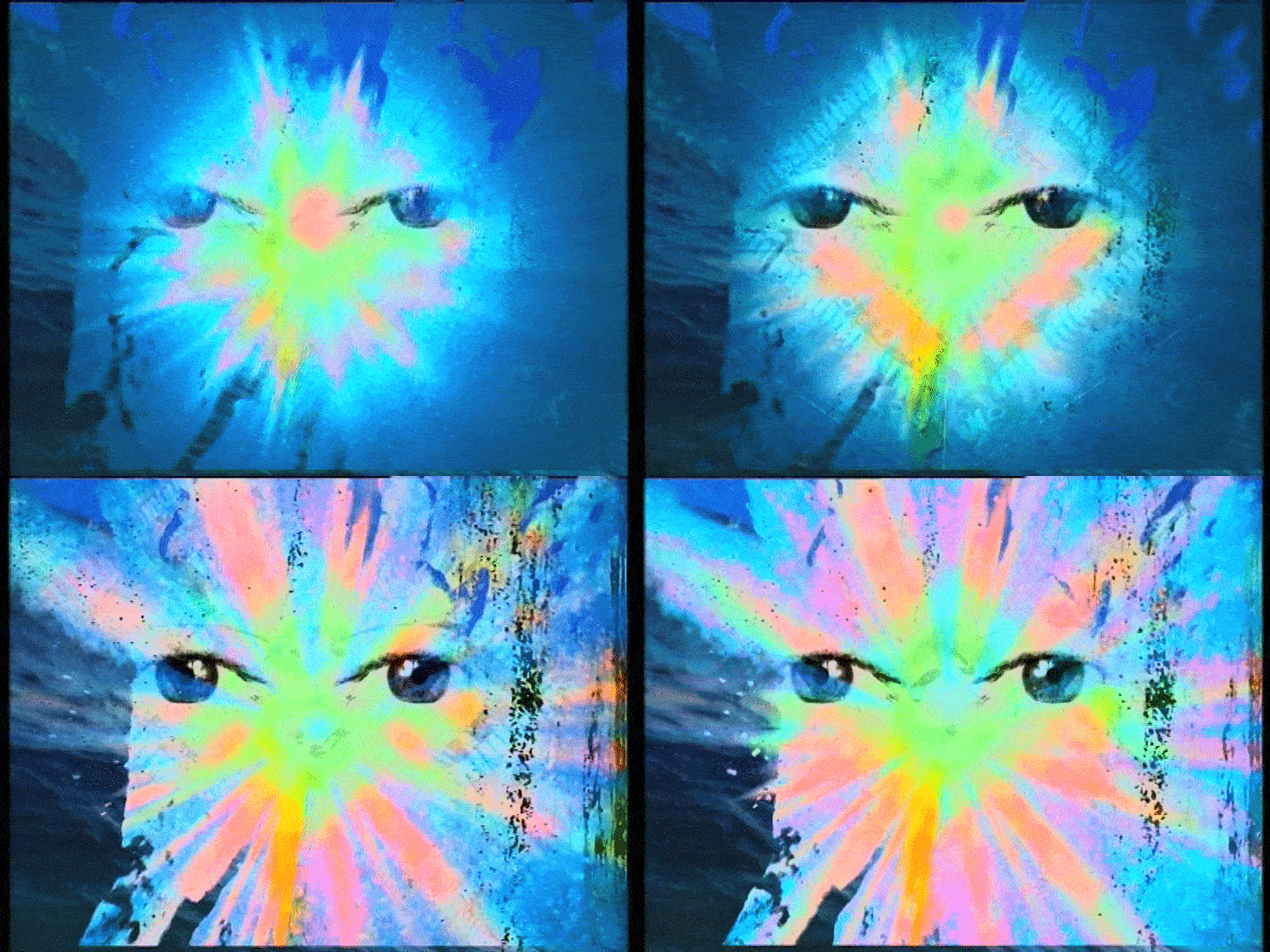
The works had been unseen for nearly thirty years, now re-emerging as artefacts that reveal the creative ferment of that era. The first drop of the RAVERSE90 collection took place in 2022, with 42 pieces sold. The second drop just landed on Exchange.art, expanding this living archive and offering a fresh look at the bold experiments of the 90s. The collection’s works are exhibited as installations — sculptures of cathode-ray television screens that echo the glow of visuals once projected in clubs and warehouses. To understand RAVERSE90 is to understand a pivotal moment in cultural history. In the early 90s, techno music burst onto the scene in France, drawing from the electronic sounds of Detroit and Chicago. Yet despite its infectious energy and innovative spirit, this underground culture was met with suspicion and hostility from the mainstream.
Cultural institutions dismissed techno as marginal, noisy, and artistically irrelevant. Show organisers resisted hosting rave parties, pushing the scene further underground. The art market ignored techno’s graphic experiments, seeing them as infinitely reproducible and therefore worthless. The media reinforced negative stereotypes — drugs, violence, deviance — painting the scene as a threat rather than a creative force. In response, the French techno scene found its voice in illegal raves, often held in abandoned spaces.
These parties became symbols of defiance and unity, offering intense collective experiences away from mainstream disapproval. By the late 90s, this underground energy bursted into the mainstream with the global success of French Touch artists like Daft Punk, Air, and Cassius, forcing institutions and the public to reconsider their stance. RAVERSE90 captures this era of exclusion and creativity, preserving the digital relics of a movement that refused to be ignored. Today, these artworks stand as reminders of techno’s early days and the spirit of experimentation that defined a generation.
Raster
Solving fragmentation
Raster offers artists a single unified profile that displays their complete oeuvre, every artwork they’ve minted, regardless of platform or chain. No more platform hopping. Just one complete, beautifully organised view. Announced in September 2025, Raster was co-founded by Michael Elsdoerfer (Masterpiece) and thefunnyguys (Le Random). Their mission is to make digital art collecting delightful by addressing one of the industry’s most persistent pain points: fragmentation. Here’s how they are achieving that: Artist Oeuvres – Each artist has a comprehensive profile uniting all minted works across networks and platforms. Market Data – Raster aggregates real-time data from major marketplaces, showing the lowest listings, highest offers, and latest sales. Collector Collections – Collectors can view their entire cross-chain collection in one streamlined interface. By bringing together artworks, data, and collections, Raster serves as a central hub for discovering, collecting, and appreciating digital art.
Raster currently supports Ethereum + L2s (Base, Shape, Arbitrum, and more) as well as Tezos. Support for Bitcoin and Solana is coming soon. The platform also integrates live data from OpenSea, Magic Eden, objkt, SuperRare, fxhash, and others, giving users a complete real-time overview of the digital art market. Collectors can buy, sell, list, and make offers directly through Raster. Each transaction is cross-posted for maximum visibility: Ethereum → OpenSea or Tezos → objkt. All with zero additional platform fees. Users can connect multiple wallets, and Raster organises their collection by artist, finally offering a holistic view of the art they own.
The sentiment around Raster has been overwhelmingly positive among both artists and collectors. On X, many artists have already begun sharing their new Raster profiles, while collectors are leaving enthusiastic comments about the platform’s simplicity and design. It’s clear that Raster is resonating with the community. With over 100,000 artist profiles and 16 million tokens across Ethereum and Tezos already indexed, Raster is emerging as the most complete digital art database in existence. Artists can request to have their profiles indexed by reaching out directly through the platform or by sending a DM to the team on X. If you’ve minted works, you can be added.
Richard Nadler
Artist Highlight
Richard Nadler is a contemporary digital artist based in Munich, Germany. Born in 1987 in Penzberg, he grew up in a family steeped in art: his grandfather was a painter, his mother an amateur artist, and his father an African art collector. This rich environment nurtured Nadler’s early creative instincts and instilled a profound respect for craftsmanship and cultural expression. Central to Nadler’s artistic vision is his enduring connection to Japanese culture. His father’s work brought him across Japan during his childhood, embedding Japanese aesthetics deeply into his artistic DNA. After his father’s passing when he was 18, these memories became a wellspring of inspiration and a means to honour their shared journeys.
“I would describe my art as a unique visual reflection of the memories that come to mind when thinking back to the trips across Japan that I took with my father.” - NFT NOW
Nadler’s professional journey took an unexpected turn when he transitioned from finance to digital art. Introduced to the Tezos blockchain and NFT scene in 2021 by friend Daniel Liebert, what began as simple curiosity soon became a passion. Amassing over 22,000 NFTs, Richard Nadler immersed himself in the community, deepening his appreciation for digital art and inspiring his own creative output. Bridging tradition and innovation, his work spans latent diffusion, generative adversarial networks (GANs), and code-based systems, using AI as a creative partner. Beginning with his own sketches, he integrates them into algorithmic workflows to produce artworks that are deeply personal and technically refined. His pieces possess a tactile, embroidery-like quality that draws viewers beyond the digital screen. Among his landmark projects are:
Japanese GenArt Collection (2021): This collection is a vibrant celebration of Japanese culture and aesthetics, reflecting the artist's deep connection to these traditions.
Gerhard (2022): In collaboration with Swiss artist Leander Herzog, a tribute to Gerhard Richter through generative animations evolving in real time.
Yamabushi’s Horizons (2023): Exploring the lives of Japan’s mountain hermits through AI-generated landscapes. This series attracted significant attention, achieving over $270,000 in secondary sales.
Izanami Islands (2023): A collection of 128 unique artworks created with a custom AI model, deeply inspired by Japanese mythology.
Ronin 浪人: Ethereal Reflections (2024): A meditation on the duality of samurai as warriors and peacekeepers, blending historical homage with AI innovation.
Beyond digital art, Richard Nadler has partnered with Vangart to produce hand-finished embroideries, merging digital with traditional craftsmanship. This hybrid approach challenges conventional boundaries within contemporary art and has earned him international acclaim and exhibitions across Europe, North America, and Asia. Based in Munich, he balances family life with his continuous exploration of generative art. His path—from finance to NFTs, from memory to algorithm—reveals an artist unafraid to blend tradition with innovation, craft with code. As ArchiTextures marks a new chapter, he continues shaping the frontier of digital art, demonstrating that code, memory, and emotion can merge into timeless works.
Serc: Veil of Echos
Visualizing your memories
What if we could turn these hidden memories into visual art? Each artwork in 'Veil of Echoes' is a private reflection, generated from your brainwave patterns. The final visual belongs to you alone, a secret portrait of your mind’s activity. By visualising these echoes, the project creates a safe space to transform painful or significant memories into something dynamic and alive. 'Veil of Echoes' invites participants to use memories as a new medium. The project begins with a free EEG device sent to each collector, who can then record their brainwave data and share it with Serc. From this intimate data, Serc creates generative visuals that map the unique rhythms of each mind. These artworks offer a blend of technology, memory, and emotion, turning personal exploration into a shared creative experience.
The collection features 100 unique 1/1 artworks, each minted on Ethereum at a mint price of 1 ETH. The initial drop took place on serc1n.xyz between May 22 and June 1, 2025. The remaining pieces are available at the ‘Veil of Echoes’ booth at NFC Lisbon, where you can also experience the IRL collection. If you can’t make it there and are interested in acquiring a piece, contact us, and we’ll connect you with the artist. For Serc, 'Veil of Echoes' is about unveiling memories within the safety of your own awareness. It reminds us that even the most subtle patterns of thought can be transformed into art and that engaging with them can reshape how we understand ourselves.
2025 Lumen Prize
Finalists Announced
For 2025, the prize fund totals $30,000, with each of the nine category winners receiving $2,000 and one exceptional work earning the coveted $12,000 Gold Award. The nine categories span from Still Image and Moving Image to Performance & Music, Hybrid, Literature & Poetry, Experiential, Fashion & Design, Nature & Climate, and Identity & Culture, reflecting the prize’s commitment to showcasing the full spectrum of technological creativity. This edition also emphasises interactivity, immersive experiences, and socially engaged work, underscoring how technology can deepen both the reach and impact of artistic innovation. Gillian Leitten, CEO of the Lumen Prize, reflects on this year’s leap in scale and conceptual breadth (Surface Magazine): “We’re attracting both emerging and seasoned professionals who have moved beyond simply using off-the-shelf technology to actively shaping their own digital systems, creating custom code, and collaborating with technology to address urgent questions. The addition of four new categories – performance and music, literature and poetry, fashion and design, and hybrid digital/physical – signals that we’re meeting artists where they actually are in their practice, and this inclusive approach extends beyond categories.”
Some standout finalists to watch include Lachlan Turczan, a finalist in the Hybrid (Digital/Physical) category who bridges corporeal experience and digital form; Sofia Crespo, recognised in both Experiential and Nature & Climate, continuing her poetic synthesis of organic and algorithmic life; SPEKTRA, in Identity & Culture, exploring the textures of heritage and collective memory; and Zhongyao Wang, featured in Moving Image, pushing narrative boundaries through time-based media. Esteban Amaro (still image) and David Sheldrick (moving image) also contribute compelling visual languages, rounding out a selection that exemplifies the diversity and innovation of this year’s finalists. Winners will be revealed in October 2025 during a weeklong celebration culminating at the Kunstsilo Museum in Kristiansand, Norway, where the Lumen Prize Award Ceremony and a series of curated events will take place. As Leitten notes, “The calibre of our finalists validates what Lumen has become: a community for artists who are redefining what art can be in our technological age.”
Sofia Crespo: Critically Extant
Perspective on the disappearing world
Crespo trained AI algorithms on millions of open-source images from around ten thousand species, generating visual representations of animals and plants that have almost no presence in social media or mainstream digital spaces. Her focus on less “charismatic” species, such as the Perote deer mouse standing on two paws, the Mekong giant catfish with its shifting patterns, and the painterly Parakaempferia synantha, underscores how bias and aesthetics shape which species gain our attention and protection. The resulting visuals often appear slightly uncanny. This reflects not only the technical limitations of AI but also the scarce data available for these endangered species. If we have so few examples of what these animals look like, how can we expect to preserve them in the real world?
Critically Extant began as an Instagram exhibition, introducing these lesser-known creatures into our daily digital intake. It has since evolved into physical exhibitions at Fellowship’s London gallery (May 21 to August 31, 2025) and at Nguyen Wahed Gallery in New York (August 4 to September 12, 2025). In these settings, visitors can encounter these AI-born species up close and consider the stories behind them. Each of the 35 video artworks is issued as a unique 1/1 NFT, with editions dropping on Fellowship.xyz starting June 5, 2025. Collectors will be able to acquire them directly on the platform, with full release information shared in advance.
More than a visual showcase, Critically Extant invites us to rethink how we use digital spaces. Crespo’s project includes AR filters inspired by critically endangered species in the New York region, allowing users to merge these threatened forms with their own images. By framing endangered species and ourselves together, she experiments with new ways to build awareness and engagement. The artist describes Critically Extant as “a project exploring the limits of available data as a means of engaging with critically endangered species.” The series is both a testament to the creative potential of AI and a reminder that digital presence can be a powerful tool for conservation. Even the smallest presence online can shape what we choose to see, share, and protect.
bottom of page