.png)
A. L. Crego
Featured in July 2026
Long before digital art became widely collected, A.L. Crego was already exploring what it meant to create art made specifically for the internet. Working exclusively digitally since his teenage years, the Spanish artist has spent over two decades developing his practice. He treats the screen rather than the gallery wall as the natural home of contemporary art. By 2014, his work had found a home on Tumblr, where he pioneered animated street art GIFs, reimagining graffiti for the digital world. Rather than documenting physical murals, Crego created works that existed entirely online, anticipating a shift that has since become central to digital culture: the internet itself becoming a public space for artistic expression. This idea formed the basis of an essay he wrote the same year. At a time when augmented reality, NFTs and virtual exhibitions were still niche concepts, Crego argued that digital space had become the new public sphere. If public art is defined by being freely accessible to everyone, he suggested, then digital art naturally inherits that role. More than a decade later, his observations feel remarkably visionary, describing a world in which artworks are encountered primarily through screens rather than physical locations.
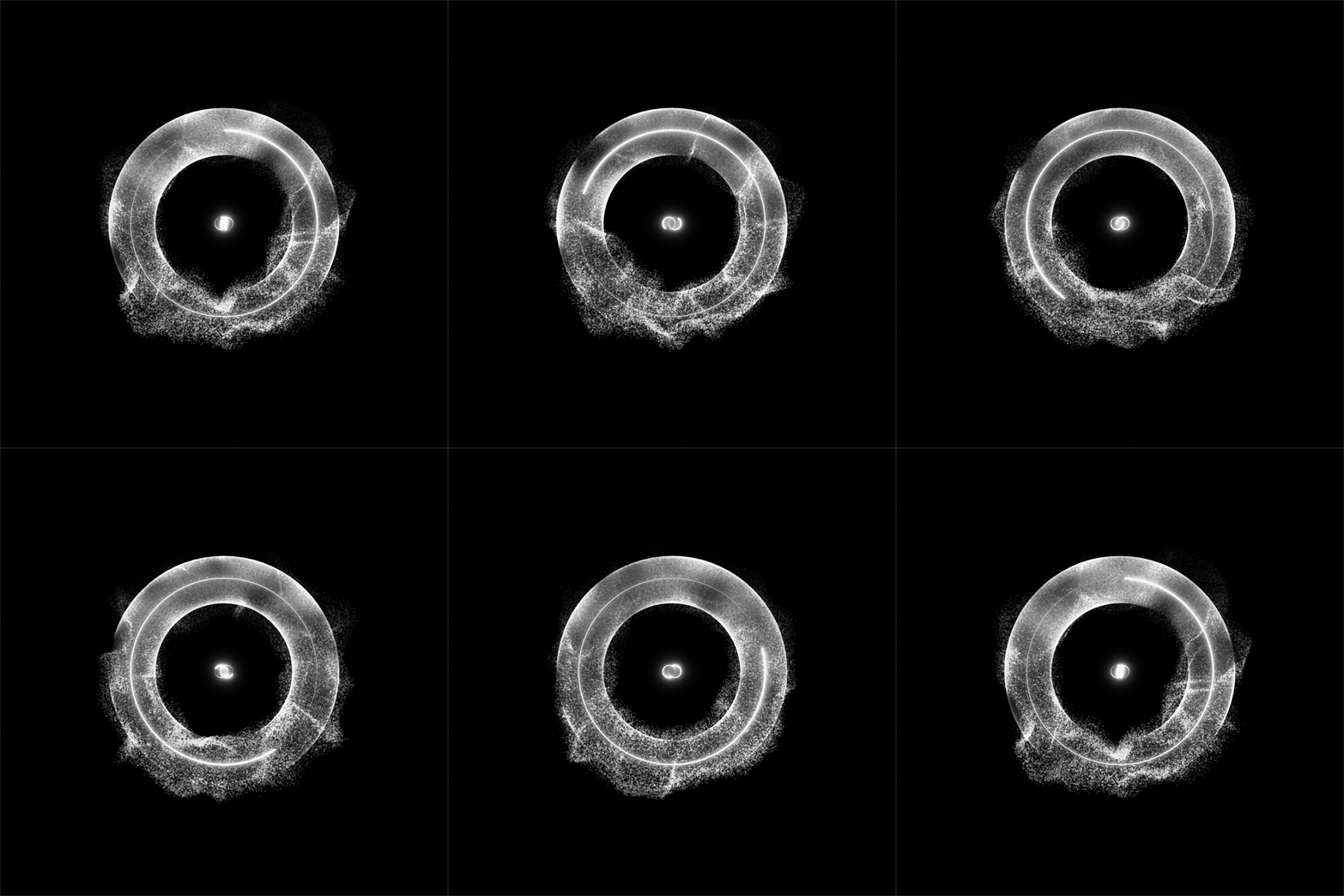
The GIF became the foundation of Crego's practice. Originally born from a desire to "do the most with the least" using limited equipment, he saw the format as something that existed between photography and video. Rather than treating the GIF as a simple file format, Crego developed it into a complete artistic practice capable of bringing together photography, painting, animation, 3D, AI, music and literature within an endless seamless loop. As he describes it, the GIF transforms the traditional timeline into a "circle line". Visually, his work is instantly recognisable. Built from dense fields of white pixels, noise and luminous traces against deep black backgrounds, his animations seem to exist between abstraction and representation. Faces, statues, architecture and landscapes emerge before dissolving back into streams of light, creating images that feel like living systems continuously forming themselves. He calls his broader philosophy No-ism. It is founded on the belief that adding "-isms" to anything risks creating a cult. His work instead embraces constant evolution, refusing stylistic permanence while returning repeatedly to questions of decentralisation, community and the nature of digital existence. These ideas extend beyond individual artworks. In 2022 he launched H3LIX, an independent decentralised gallery built around 300 1/1 works, custom smart contracts and virtual reality. More than an exhibition space, H3LIX reflects Crego's belief that digital art should remain independent of any single platform. His practice similarly adopts a chain-agnostic approach to blockchain technology, treating networks as vehicles for artworks rather than defining features of them. Crego has built an extensive body of work over the years. His long-running series form an interconnected ecosystem where each project expands upon the last. Taken together, they reveal an evolving philosophy. Through pixels, light and perpetual motion, he has developed a style that feels simultaneously ancient and futuristic, as though excavating digital ruins from a civilisation that has yet to exist.
Artworks


Previous
Next